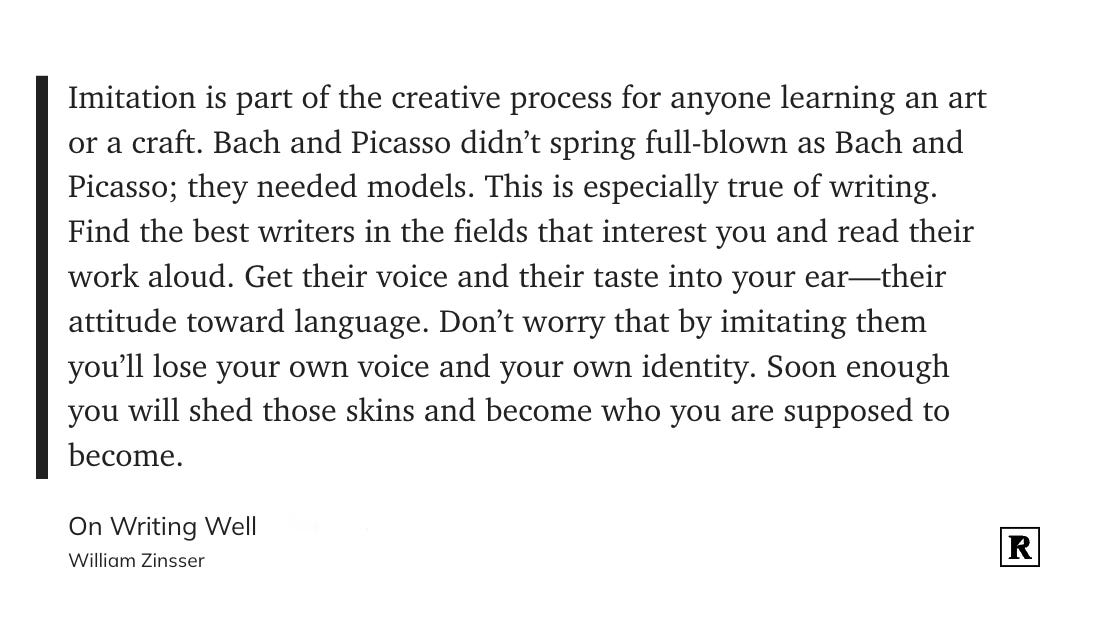
Progress rarely springs from a vacuum, it builds on the accumulated wisdom of those who came before. I always prioritized learning from key thought leaders in the few areas of interest I have as a vantage point to see further and reach higher.
Copying their good habits, ways of thinking, and modus operandi, “I regard it as a criminal waste of time to go through the slow and painful ordeal of ascertaining things for oneself if these same things have already been ascertained and made available by others,” that's Thomas Edison on what we would call at Legend, “starting from 50."
On having mentors
My mentors provide guidance, inspiration, and hard-won intelligence because they have been there and done that. I'm lucky to have met a few, most I will probably never share a meal with, and a few are not even alive. Books, historical figures, and contemporary leaders all serve as mentors as I seek wisdom wherever I can find it.
Seneca frames the relationship clearly, “the ones who pioneered these paths aren't our masters, but our guides. Truth stands open to everyone; it hasn't been monopolized.”
“I think you learn economics better if you make Adam Smith your friend. That sounds funny, making friends among the "eminent dead," but if you go through life making friends with the eminent dead who had the right ideas, I think it will work better for you in life and work better in education,” how Charlie Munger would coach young students.
You also have to have mentors, dead or alive.
You have to connect with a body of work or someone who formulated a thought, an aesthetic, and then build years upon that.Most people won’t tell you is that the people that you look up to didn’t invent it themselves. You know, everyone has this sort of like, I call it “getting your brain reprogrammed”.
— Virgil Abloh’s lecture at Harvard University
When I think that high-performing athletes, in the likes of Serena Williams or LeBron James, have coaches for correction, why shouldn’t we have coaches for areas we lack? It's a no-brainer.
Now, the mistake of many is to narrow their thinking and over-index to a single dimension of their lives. They need to lose weight, so they look for a trainer, and that's it. Job-seekers chasing career advisors. Newly rich on the phone with wealth managers.
When I think about how I grow, it's clear that one of my best moves was surrounding myself with coaches for each area of the life wheel, people with reliable advice that enable me to move faster, because smart people learn from their own mistakes, but wise people learn from the mistakes of others.

I think one of the problems we have today is we don’t have heroes, we don’t have role models and heroes. Because so many people are interested in tearing down people.
— Ray Dalio, interview with Charlie Rose
Creation requires influence
I believe in the discipline of mastering the best that other people have ever figured out. I don't believe in just sitting down and trying to dream it all up yourself. Nobody's that smart, that's what Charlie Munger would say.
To me, originality is very often overvalued because people confuse being original with being authentic. Most breakthroughs come from combining and refining existing ideas, not inventing new concepts. Embrace learning from others and make unique contributions by applying knowledge in new contexts, connecting dots in new ways, and not starting from scratch.
I often reference Monish Pabrai, who calls himself “a shameless copycat.” Most things in his life he cloned; he claims to have no original ideas, yet when you think of the Indian Buffet, his mustache is the only thing you can think of.
Is he original? No.
Authentic? For sure.
When asked why more people don't copy the way he does, his answer is sharp and simple: “They're not as shameless as me. They have more ego. To be a great cloner, you have to check your ego at the door.”
If you learn, basically, from other people, you don’t have to get too many ideas on your own. You can just apply the best of what you see. Inevitably, everything we create is a synthesis of our experiences and influences, a remix of existing creations.
Mike Taylor brought Everything is a Remix to my attention while on a visit to Manchester back in 2024, on a MEATup at Miller and Carter, a great memory.
The information diet
Just as our bodies thrive on a balanced diet, our minds flourish on a well-rounded information diet.
The content we consume profoundly influences our thoughts, decisions, and ultimately, the mentors we look up to. The internet is busy, curation is key. The Compound Life is my approach to curation, choosing and paraphrasing from those who offer wisdom. No information junk food.

Last one from Seneca, my favorite Stoic, choose a master whose life, conversation, and soul-expressing face have satisfied you; picture him always to yourself as your protector or your pattern. For we must indeed have someone according to whom we may regulate our characters; you can never straighten that which is crooked unless you use a ruler.
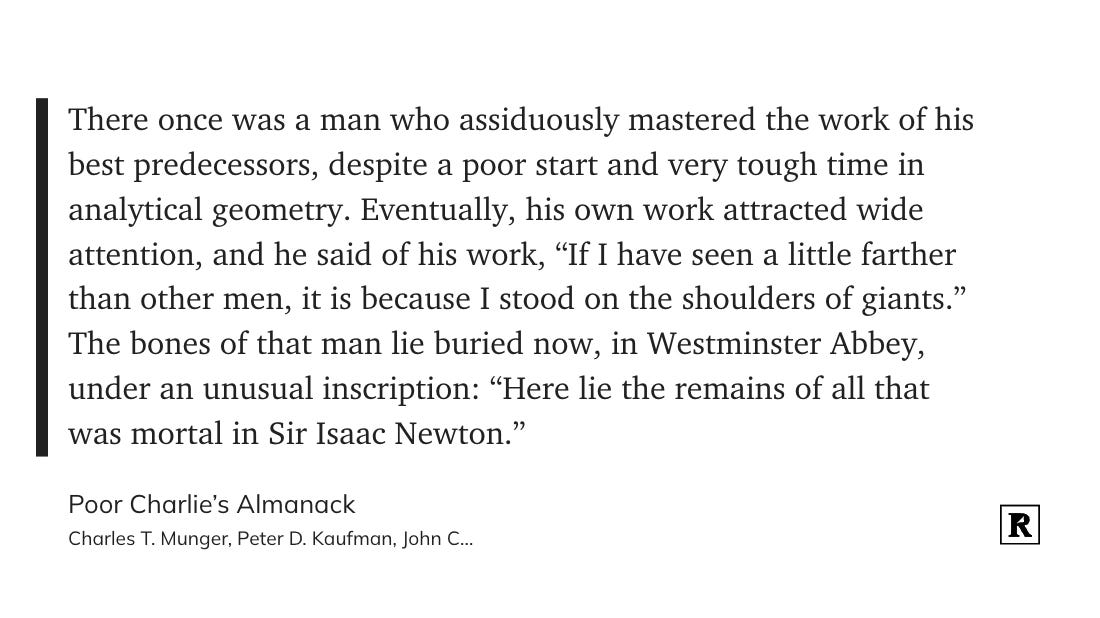
Find your giants and stand on their shoulders; there's no reason to start from scratch.
Sources of wisdom
Chen, C. (2003). On the Shoulders of Giants. In: Mapping Scientific Frontiers: The Quest for Knowledge Visualization. Springer, London.
Tao of Seneca, Vol. 1, Tim Ferriss.
Poor Charlie's Almanack: The Wit and Wisdom of Charles T. Munger.